
Pashupatastra Healthcare — Navigation Header

Healthcare AI development

Agents, document intelligence and predictive models, scoped to real tasks and reviewed by a person where it matters.

Healthcare-focused engineering team
Human review at defined points
Designed for HIPAA-regulated environments
Healthcare AI

AI is where we start, not where we finish

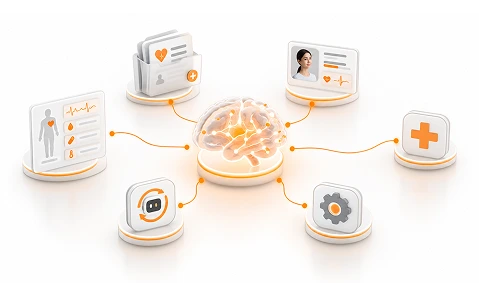
Healthcare AI works today in administrative and operational tasks, where rules are known and mistakes can be corrected. We scope it there first, then build the product around it.

Deterministic AI Governance Pipeline

Interactive execution path for clinical AI inference

STAGE 01
USER REQUEST
Direct clinician input or patient intake message with PHI filters.
STAGE 02
APPROVED SOURCES
Clinical protocols, verified guidelines, locked formulary index.
STAGE 03
RETRIEVAL
Semantic vector lookup with strict relevance thresholding.
STAGE 04
REASONING
Domain-constrained model synthesises answer strictly citing sources.
STAGE 05
CONFIDENCE / POLICY
Automated boundary checks and safety policy evaluation.
HIGH CONFIDENCE (>95%)
AUTOMATED ACTION
Audit event logged with source hash
AMBIGUOUS / COMPLEX
HUMAN REVIEW
Escalated to named clinician
Status: User / Clinician Request Received • Live Telemetry Pipeline Policy: Zero-Hallucination Guardrails
01

Patient support automation

Handle routine questions about appointments, preparation, results and billing, using your approved content, with anything unusual passed to a person.

Approved Sources Only
02

Document and referral processing

Referrals, intake forms and scanned correspondence turned into structured data, with low-confidence items sent to a review queue rather than guessed.

Review Queue Route
03

Operational AI agents

Multi-step administrative tasks completed within set permissions: eligibility checks, record updates, status chasing. Every action is logged.

Audit Logged
04

Knowledge assistants

Fast answers from your own policies and protocols, with a citation back to the source document so staff can check the answer.

Source Citations
05

Predictive analysis

Risk patterns, capacity pressure and care gaps surfaced early enough for someone to act on them.

Early Detection
06

Decision support

Relevant information assembled and prioritised so a clinician reaches a decision faster. The decision stays with the clinician.

Human-in-the-Loop
Large language models
Retrieval and grounding
AI agents
Document intelligence
Predictive models
Computer vision
Evaluation and guardrails
Private deployment
AI Governance & Controls
“Every AI system we build carries the same controls: human review at defined points, permissions set per action, answers grounded in approved sources, a full audit log and a named escalation path.”
Human review at defined points
Permissions set per action
Answers grounded in approved sources
Full immutable audit log
Named clinician escalation path
Experience

Our work in numbers

Every figure here is drawn from delivered work and reviewed before publication. Where a number cannot be evidenced, it is not on this page.

12+
Years of combined engineering experience in clinical software & protocols
34+
Digital healthcare products and production services delivered
18
Healthcare and connected care telemetry projects in active deployment
45+
Integrations with medical devices, EHRs and clinical telemetry systems
7
Countries where our production engineering work is actively in use
Healthcare domain expertise

Where we work inside healthcare.

These projects rarely fail on the code. They fail on what was not obvious at the start: a proprietary device format, a consent rule nobody mentioned, or a clinical system that will not be replaced.
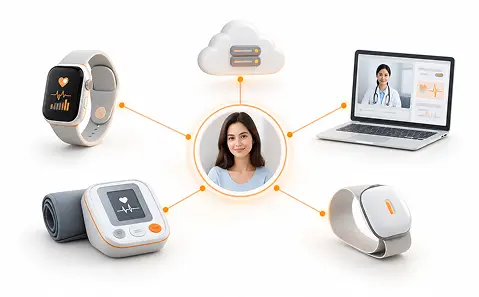
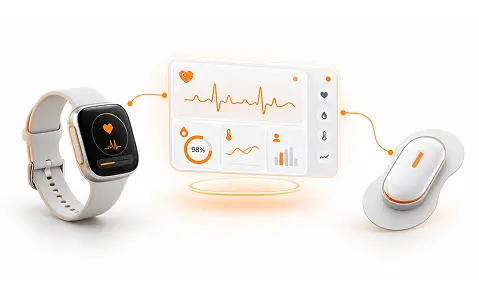
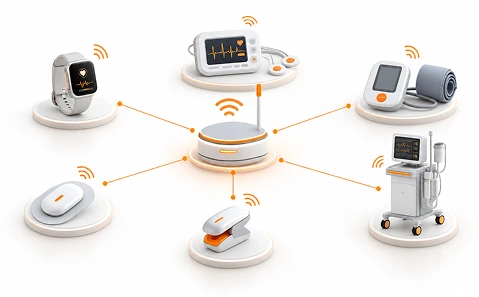
Connecting devices, data and care teams

A reading that arrives late, attaches to the wrong record or fires an alert nobody reads has no clinical value, however good the device is.

Device connectivity Device data ingestion Wearable integration Real-time monitoring Sensor integration Edge processing Alert management Device dashboards Fleet monitoring Device analytics
Engineering Scope & Regulatory Integrity We build the software, data services and applications around connected devices. We are not a regulated medical device manufacturer, and we will tell you early if your project needs a regulatory route rather than an engineering one.
In use

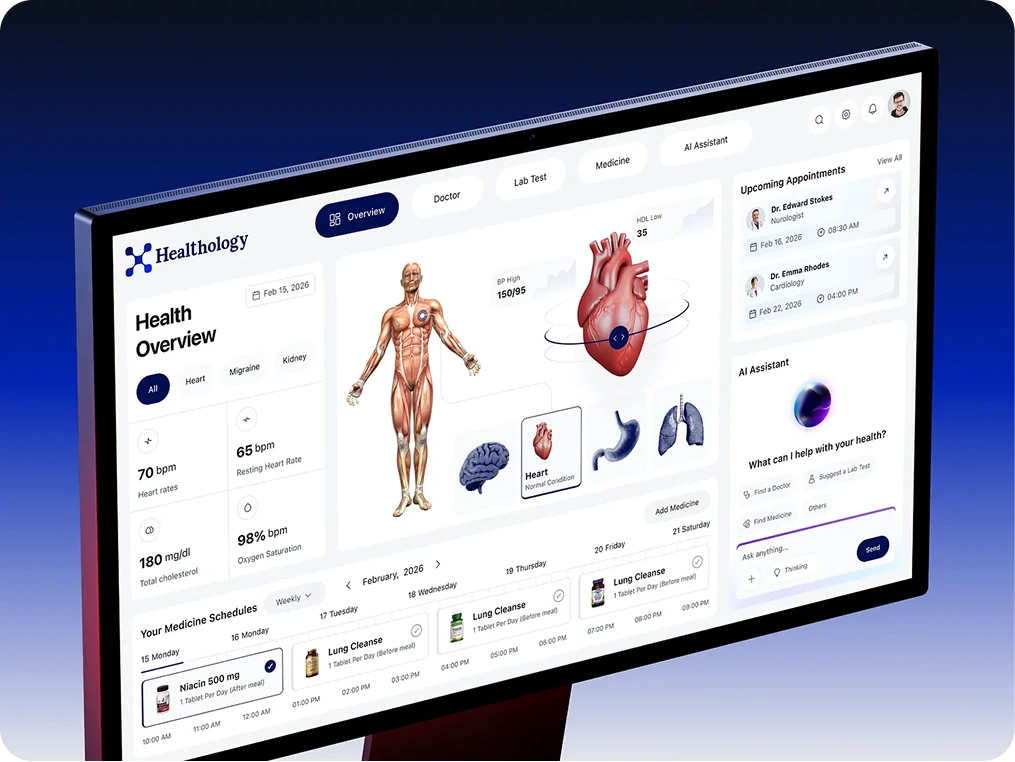
Healthcare AI in practice

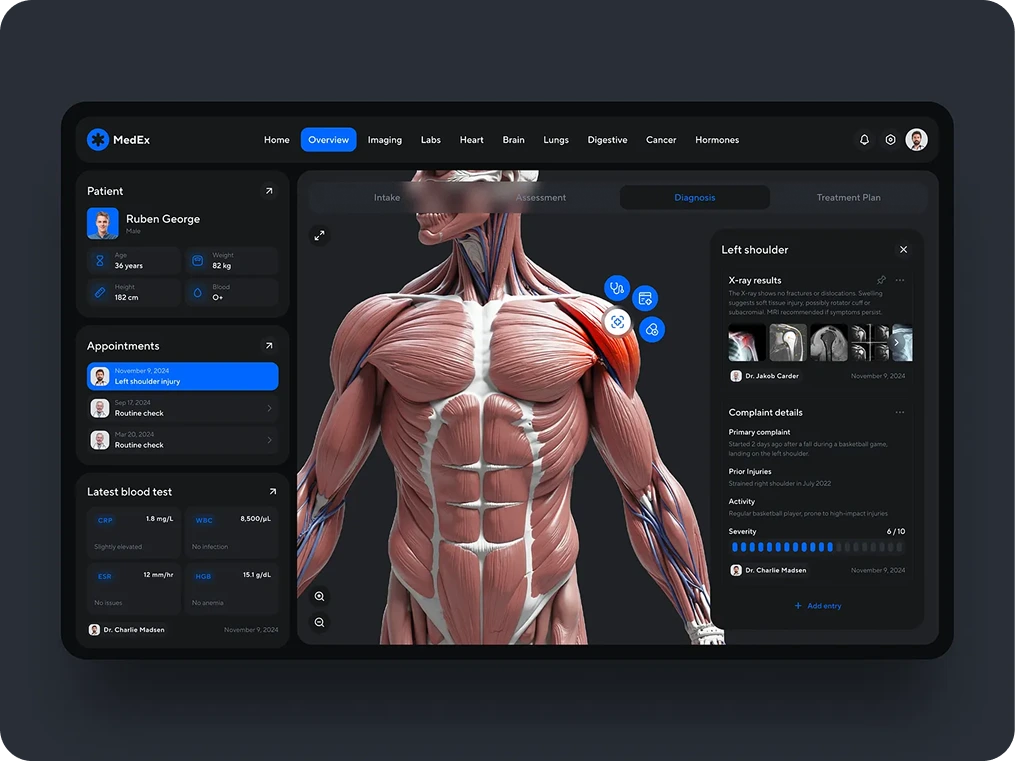
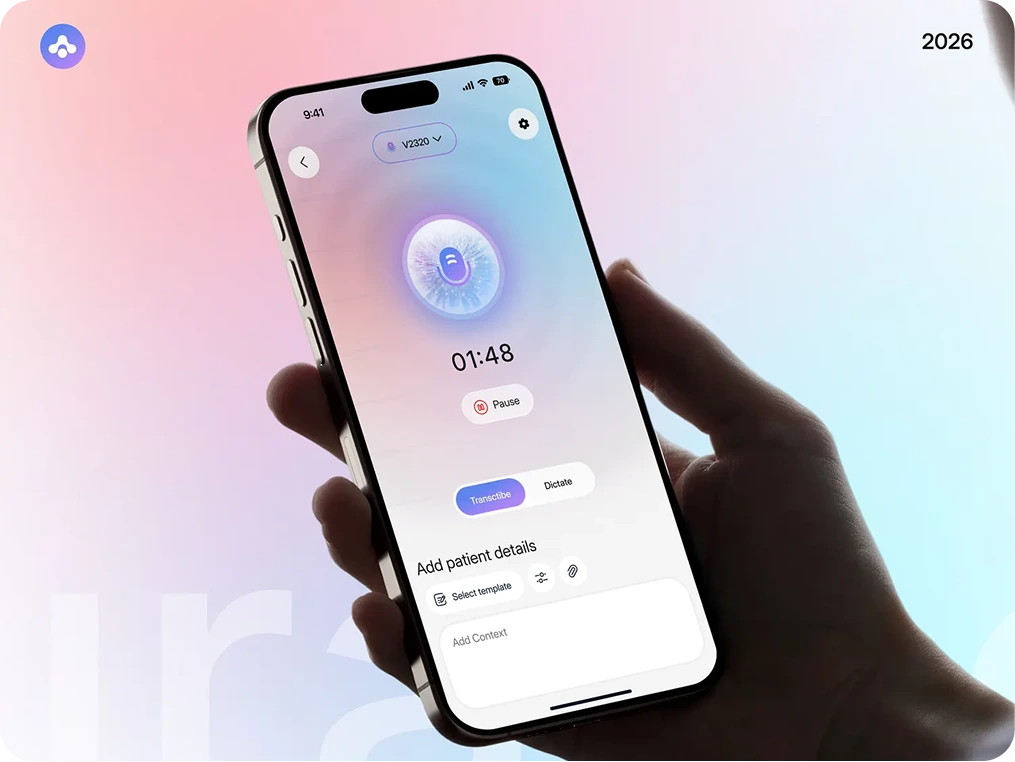
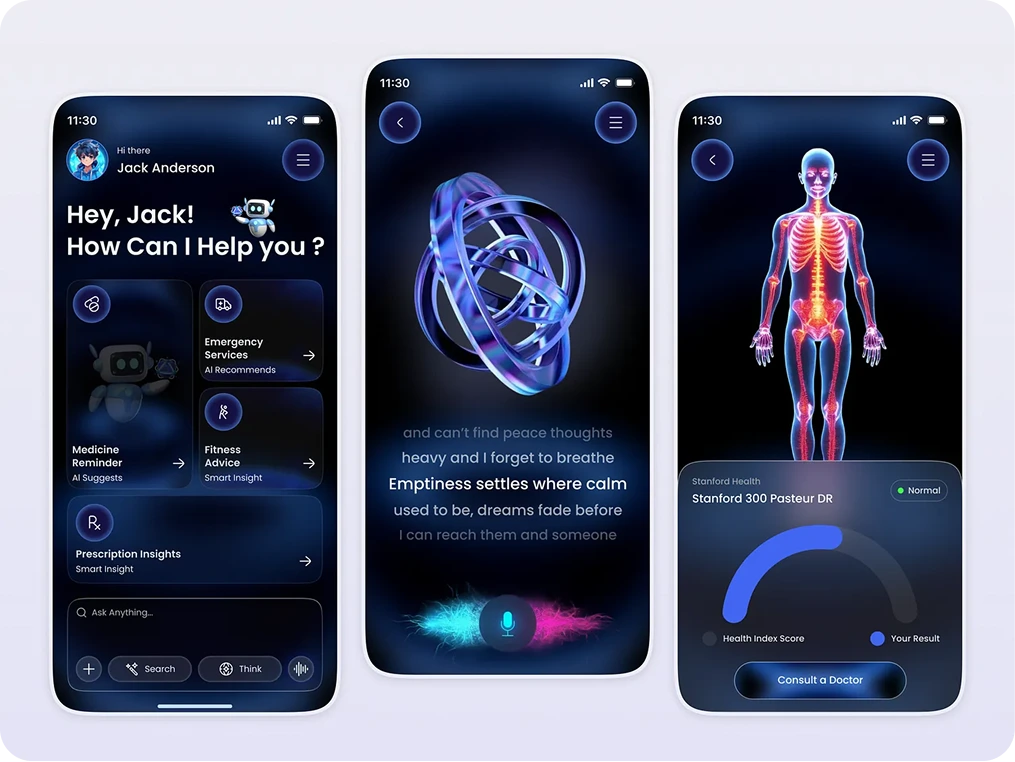
Screens from AI work, with any patient data regenerated as synthetic records.

What We Build

Everything between the idea and the system in production.

Most projects need several capabilities at once. Monitoring alone can require device work, a data layer, applications and integration. It is easier when one engineering team holds the whole system.

Artificial Intelligence
02

Healthcare AI

Grounded agents for administrative triage, document intelligence and knowledge assistants with strict source citations and human review.

IoMT
03

Healthcare IoT and connected care

Resilient device-to-cloud ingestion over BLE, MQTT and cellular gateways, buffering readings through connectivity dropouts.

Clinical Telemetry
04

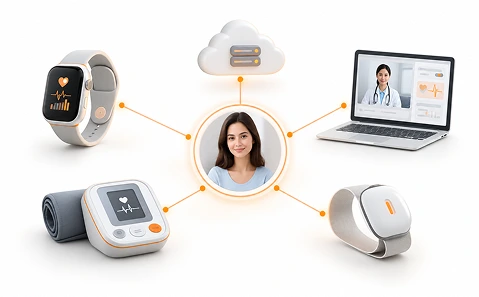
Remote patient monitoring

End-to-end telemetry pipelines from home sensors to triage dashboards with escalation thresholds and synthetic data validation harnesses.

Data Systems
05

Healthcare data and analytics

High-throughput transformation pipelines, HIPAA de-identification layers and longitudinal patient data models for operational insights.

Interoperability
06

Interoperability and FHIR

Translation layers between legacy HL7 v2 feeds and HL7 FHIR R4 resources, enabling EHR bi-directional synchronisation and SMART on FHIR apps.

Who We Work With

Founders building the first version. Teams scaling the one that worked.

We partner with teams that need deep healthcare engineering capability without the multi-month ramp-up of educating generalists on clinical systems.

01

HealthTech startups and scaleups

Accelerate time-to-market with production-ready architectures, avoiding regulatory refactors later.
02

Hospitals and healthcare providers

Modernise intake, streamline referral routing, and deploy AI assistants grounded strictly in your clinical protocols.
03

MedTech and connected devices

Build the companion apps, ingestion backends, and EHR interoperability bridges around your medical hardware.
04

Digital health companies

Scale telemetry infrastructure, add automated patient workflows, and ensure cross-platform biometric synchronization.
05

Healthcare organisations in Africa

Resilient digital health architectures engineered for local connectivity conditions and national regulatory frameworks.
06

Researchers, colleges and R&D teams

Turn algorithmic discoveries and clinical trials into validated software and structured research data pipelines.
Why Pashupatastra

Why healthcare organisations work with us

The practical reasons clients choose us. The evidence sits elsewhere on this site, not in the claim.

We don't sell generic wrapper bots. We build constrained, deterministic architectures with retrieval-augmented generation (RAG) grounded in your validated medical and administrative corpora, complete with confidence scoring and escalation paths.

Most healthcare challenges span Bluetooth firmware, cloud ingestion, clinical UI, and EHR integration. We eliminate the coordination cost of managing four separate vendor teams by unifying full-stack engineering under one roof.

We understand edge buffering, lossy cellular connections, Bluetooth pairing edge cases, and battery optimization across continuous medical sensors, ensuring clinical vitals are never dropped in transit.

We do not build retail apps one week and healthcare platforms the next. Our engineers already understand HIPAA, BAA agreements, FHIR R4 schemas, and the clinical reality of alert fatigue.

You speak directly to the architects who write your code, design your database schemas, and deploy your infrastructure. No junior bait-and-switch or layers of non-technical account managers.

We take clinical technology from early MVP validation through to multi-region cloud deployment supporting millions of daily medical telemetry events without architectural rebuilds.

Our People

Real photographs. Verified engineers. Zero stock portraits.

Judgement belongs to people, not companies. These are the people who would be on your project.

Leadership & Engineering Core

The people behind the work

Profiles reflect the actual engineering leaders responsible for system delivery.

Head of Engineering
Engineering Lead
Connected device platforms, cloud infrastructure, high-concurrency data pipelines, zero-trust healthcare networks.
LinkedIn Profile →
AI Lead
Applied AI Lead
Applied AI, retrieval-augmented systems, clinical safety evaluation, model governance, latency optimization.
LinkedIn Profile →
IoT Lead
IoMT Systems Lead
Device connectivity, ingestion at scale, edge processing, BLE protocols, embedded firmware communications.
LinkedIn Profile →
Solution Architect
Healthcare Architect
Healthcare integration, FHIR R4 and HL7 standards, HIPAA compliance architectures, identity federation.
LinkedIn Profile →
How We Work

Six stages, from first conversation to live service

The order rarely changes, though the depth of each stage does. A proof of concept and a regulated device platform follow the same route at very different speeds.

01
Understand
Clinical workflow assessment, data sources mapping, boundary definitions, regulatory risk discovery.
02
Plan
Architecture blueprint, FHIR resource definitions, latency budgets, security perimeter design.
03
Build
Agile implementation sprints, automated test suites, infrastructure-as-code, synthetic test feeds.
04
Test
Vulnerability scanning, penetration audits, edge failure simulation, end-to-end telemetry verification.
05
Launch
Zero-downtime cutover, clinical telemetry verification, telemetry monitoring, failover readiness.
06
Support & improve
Continuous monitoring, model drift evaluation, security patching, clinical capacity scaling.
Product engineering team Dedicated healthcare engineering team AI proof of concept MVP engagement Fixed-scope project Modernisation Long-term support
Security & Responsible AI

How we handle patient data and AI.

Two questions come before everything else: what happens to the data, and what happens when the AI is wrong.

Defense-in-depth

Security is not one control. It is a chain of controls.

Every layer of our healthcare infrastructure is designed to preserve confidentiality, enforce attributable access and prevent autonomous AI errors from reaching clinical workflows unchecked.

Standards Compliance & Honesty Policy

We design systems to support HIPAA-regulated healthcare environments and work to GDPR, HL7, FHIR and ISO 27001 practices where an engagement requires them. We do not claim certifications we have not been independently audited against.

Security Architecture Defense layers active
01
Data ingestion Controlled entry points and service boundaries
Zero Trust
02
Encryption Data protected in transit and at rest
TLS 1.3 · AES-256
03
Access control Least-privilege permissions by identity and role
RBAC / ABAC
04
Audit trail Attributable and immutable activity records
Signed Logs
05
AI governance Approved knowledge and traceable output sources
Source Citations
06
Human review High-impact decisions remain human-controlled
Clinician Lock
01 / PROTECTION

Data protection by design

Encryption in transit and at rest, role-based access, data minimisation and hosting location decisions are built into the architecture from the beginning.

02 / AUDIT

Access and audit

Every action against patient data is attributable to a user or service with immutable, time-stamped telemetry.

03 / HUMAN CONTROL

Human review of AI output

Review points are determined by what the output affects. High-risk decisions require named clinician authorization.

04 / TRACEABILITY

Answers with a source

AI responses cite approved source material, allowing clinical staff to audit the underlying evidence immediately.

05 / MONITORING

Testing and monitoring

Security testing, process testing and continuous AI evaluation before release and throughout live operation.

06 / RESPONSIBILITY

Clear division of responsibility

Controls are clearly divided between Pashupatastra, cloud providers and clients across the shared security model.

Verified Feedback

Independent Client Reviews

Direct feedback from clinical engineering leaders, health system CTOs, and MedTech founders who run our software in clinical production.

4.9
Based on 40+ verified client engineering engagements
Google Verified Business Reviews
Pashupatastra Healthcare AI ©
Google Review

“Zero packet drops in our BLE biometric pipeline.”

“Pashupatastra engineered our continuous cardiac telemetry infrastructure from raw Bluetooth packets to FHIR R4 observations. Their understanding of low-power mobile Bluetooth reconnection and HIPAA BAA requirements gave our clinical advisory board complete peace of mind.”

DV
Dr. David Vance, PhD
VP of Engineering · BioMetrics Connected Health
RPM · MedTech (Boston, MA)
Google Review

“Saved our team 6 months of EHR integration delays.”

“Converting legacy HL7 v2 ADT/ORU messages into SMART-on-FHIR apps that launch inside Epic and Cerner was our biggest bottleneck. Pashupatastra resolved our schema impedance without disturbing hospital clinical staff.”

ER
Elena Rostova
Chief Technology Officer · Regional Health Network
Interoperability · Hospital Systems (Chicago, IL)
Google Review

“A truly clinical AI architecture with deterministic guardrails.”

“Unlike standard AI agencies peddling loose chatbot prompts, Pashupatastra engineered deterministic validation chains and clinician-in-the-loop escalation rules. Our doctors trust the outputs because every inference cites clinical guidelines.”

KM
Dr. Kwesi Mensah
Head of Digital Health · Global Health Alliance
Clinical AI · HealthTech (Nairobi & London)
Where We Work

Working across international healthcare markets

Hosting rules, national health registries, local cloud sovereignty, and procurement differ profoundly across jurisdictions. We audit regulatory architectures country-by-country before engineering code.

REAL-TIME JURISDICTION TELEMETRY
EQUATOR 0°00'N PRIME MERIDIAN 0°00'E US · HIPAA & ONC FHIR EU · GDPR ART.9 / MDR UAE · NABIDH / MALAFFI INDIA · ABDM M1-M3 AFRICA · SOVEREIGN & EDGE
United States HIPAA AUDITED
45 CFR § 164 • US CORE FHIR
Residency: AWS GovCloud / Azure US-East
Standards: HL7 FHIR R4, SMART on FHIR, DICOM
Security: AES-256 GCM • TLS 1.3 mTLS
United States HIPAA BAA • ONC FHIR
HIPAA Security Rule compliance, Business Associate Agreements (BAA), US Core FHIR profiles, and FDA software cybersecurity verification.
India ABDM Certified Bridge
Ayushman Bharat Digital Mission (ABDM) milestone certification (M1, M2, M3), Health ID (ABHA) creation, and HIP/HIU gateway integration.
Africa Country-by-Country
Pan-African deployments evaluated nation-by-nation. Built for data sovereignty, low-bandwidth edge synchronization, and national health registries.
United Arab Emirates NABIDH • Malaffi
UAE Health Data Law compliance, in-country sovereign cloud hosting, and bi-directional integration with DHA NABIDH and DoH Malaffi.
European Union & UK GDPR Art. 9 • EU MDR
Strict special category health data governance, NHS Digital standard compliance (DCB0129 / DCB0160), and EU MDR software qualification.
Direct Senior Engineering Access

Build healthcare technology with the right team.

Speak directly with senior healthcare technology specialists about architecture, interoperability, AI, compliance, integrations, and your next product milestone.

✓ Senior engineers
✓ Healthcare expertise
✓ No sales-layer handoff
Start a conversation

Have a healthcare technology challenge?

Share what you're building and discuss the technical path forward with our engineering team.

Talk to Our Engineering Team →
A technical conversation — not a generic sales call.