

Remote patient monitoring
software development
Readings that arrive reliably, reach the right patient record, and land in front of the right clinician.
Collecting the reading is the easy part
A reading has to arrive on a poor connection, attach to the right patient, be judged against their own history, and reach someone while acting still matters. Programmes fail for three reasons: patients stop using the device, clinicians stop trusting alerts, or nobody owns the queue.
What we build
Enrolment and device assignment
Registering a patient, assigning and pairing devices, recording consent, and handling the day a device is replaced.
Reliable data collection
Ingestion designed for intermittent connectivity, with retries, backlog handling and original timestamps preserved.
Patient identity matching
Every reading tied to the correct patient, including shared households and reassigned devices.
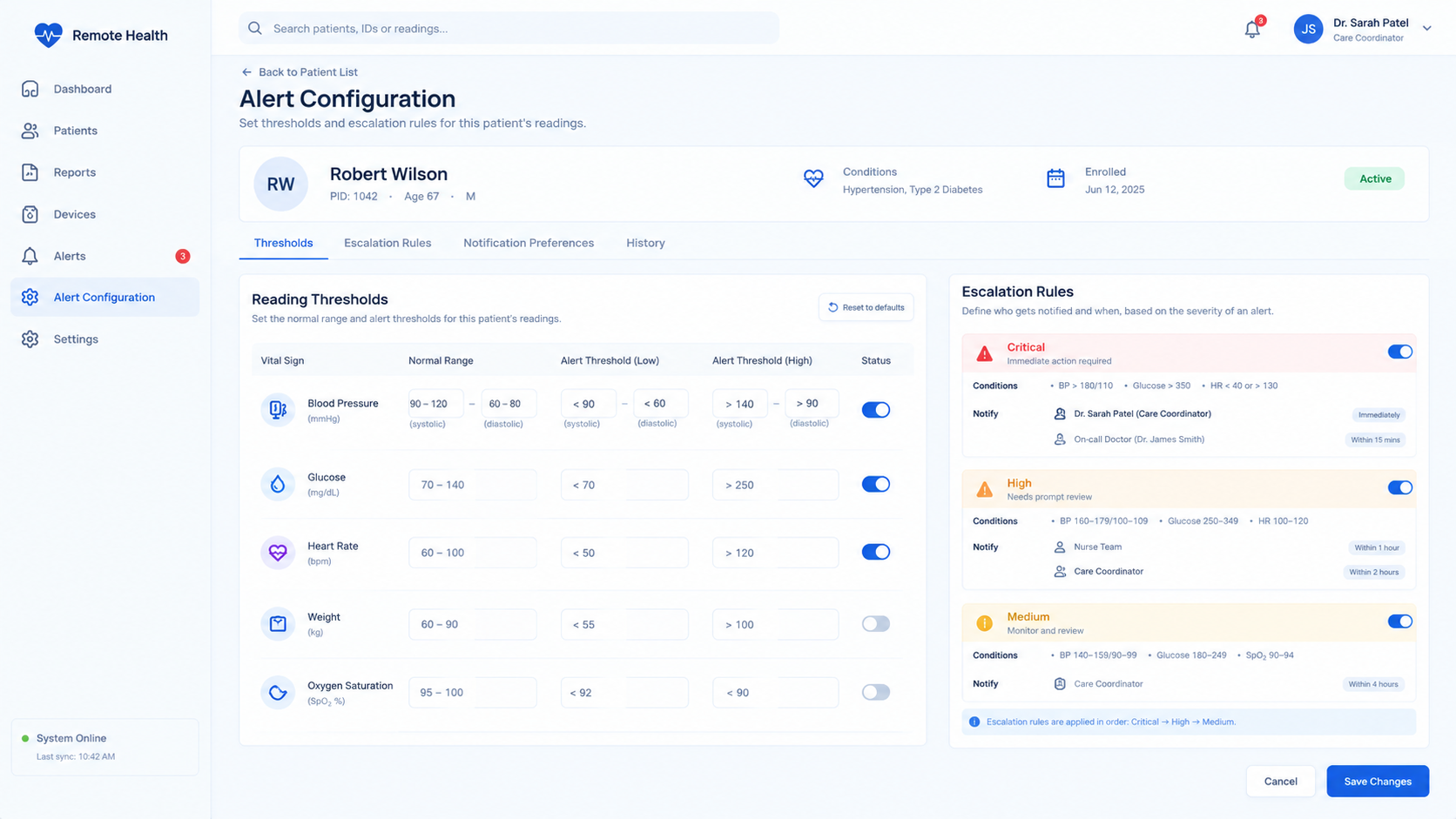
Thresholds and trends
Rules based on the patient’s own baseline as well as population thresholds, so a stable patient does not generate daily alerts.
Alert routing and escalation
Severity, routing to the right role, required acknowledgement, and escalation when an alert is not answered.
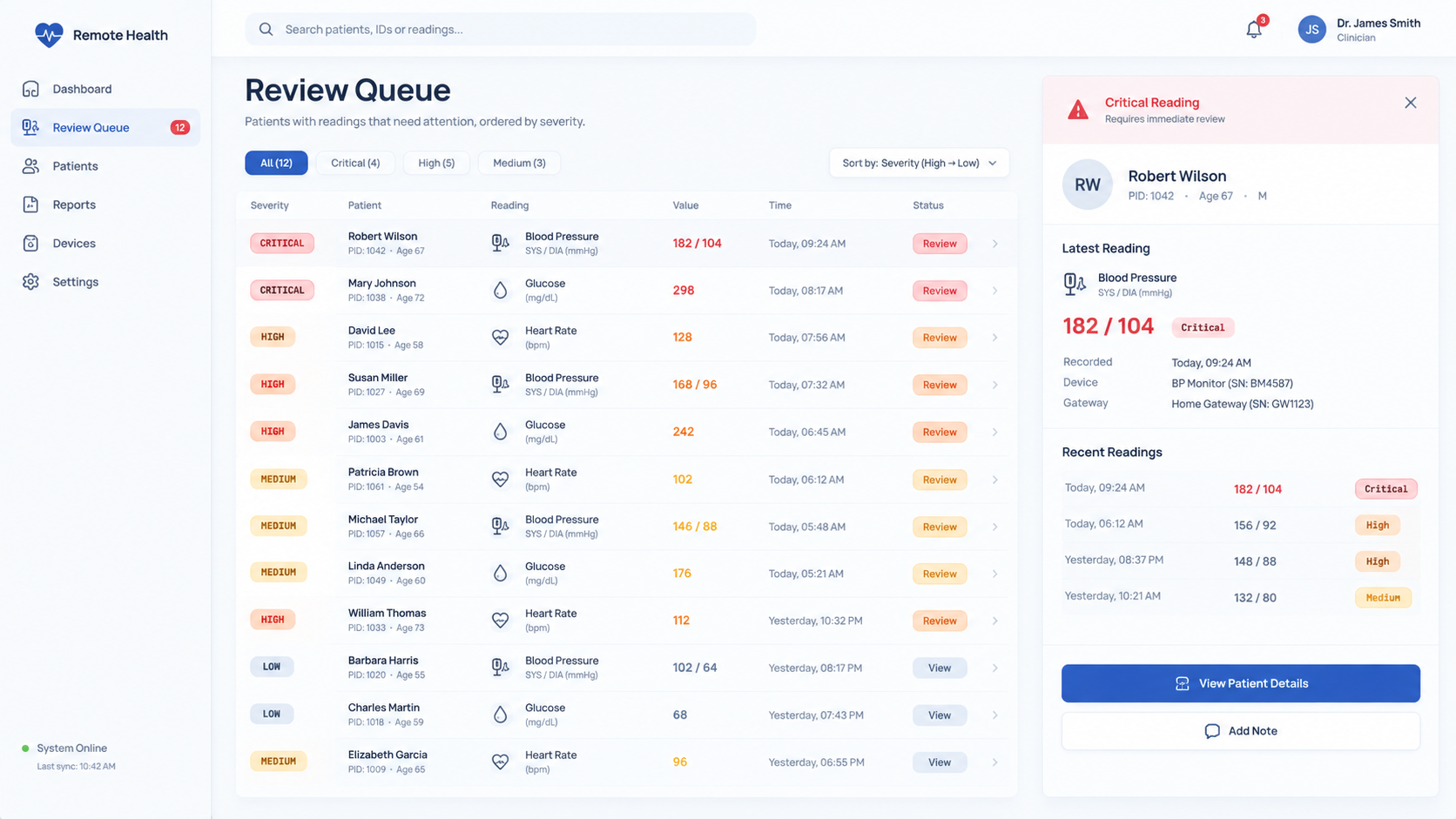
Clinician review queue
A working view showing what needs attention now, what is waiting, and what has been handled.
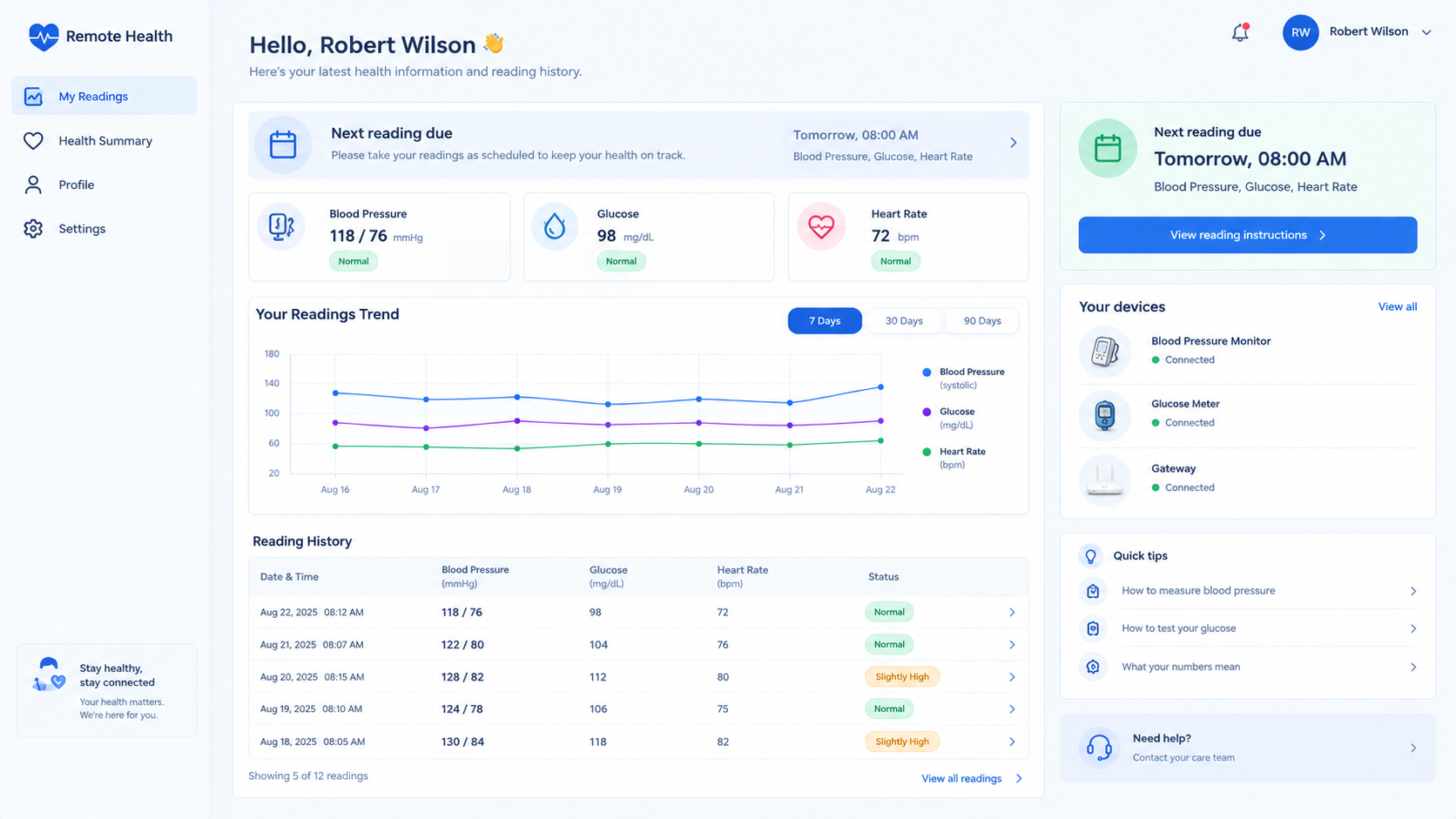
Patient application
A simple view showing patients their own readings, prompting when one is due, and confirming when it has been received.
Adherence tracking
Which patients are taking readings, which have stopped, and who needs a call.
Clinical system integration
Writing readings and summaries into the EHR at a level of detail clinicians can actually read.
A monitoring programme in practice
What this looks like in practice
| Programme type | Typical measures | Who reviews |
|---|---|---|
| Chronic disease management | Blood pressure, weight, glucose, symptom questionnaires | Practice nurse or care coordinator |
| Post-discharge monitoring | Vital signs, symptoms, medication adherence | Discharge or community team |
| Cardiac monitoring | Heart rate, rhythm data, activity, weight | Cardiology team |
| Respiratory monitoring | Oxygen saturation, peak flow, symptom scores | Respiratory or community team |
| Maternity monitoring | Blood pressure, weight, foetal movement reporting | Midwifery team |
| Post-operative follow-up | Wound images, pain scores, mobility | Surgical follow-up team |
Security and consent
Monitoring data is collected in a patient's home and identifies them directly. Consent needs recording, withdrawal needs handling properly, access needs restricting by role, and every view of a record needs logging. Data hosting location often matters more in monitoring than in other healthcare projects, because the data is continuous and the patient is identifiable throughout.
Devices supported
Frequently asked questions
Direct answers on patient adherence, multi-device support, EHR synchronisation, alert routing, and store-and-forward offline buffering.
Mostly through design rather than technology. Readings due at a predictable time, a clear confirmation that the reading was received, a simple view of their own history, and a prompt that escalates to a phone call rather than repeating itself. Adherence reporting then tells the team who needs contacting.
Yes, and most programmes end up needing it. The work sits in the mapping layer, where readings from different manufacturers are converted into one consistent structure with units and timestamps handled correctly.
Not always, but clinicians generally want it where they already work. A common approach is to write a periodic summary and any alert into the record, while the full reading history stays in the monitoring platform and is reachable from a link.
Your team. We build the routing, acknowledgement and escalation rules around the staffing you actually have, including out of hours. Deciding this early usually changes the design of the alerting.
Yes. Readings are stored on the device or gateway and sent when a connection is available, with original timestamps preserved. Where connectivity is very limited, a store-and-forward gateway is often more practical than continuous transmission.
Talk to us about a monitoring programme
Bring the population, the devices you are considering and the team who will respond. Those three answers shape most of the design.