

Healthcare interoperability
and integration services
Connect your product to EHR and clinical systems using HL7 and FHIR.
Your product has to work with systems you do not control
Integration is the part that slips. The standard is published, but the installation in front of you implements a subset of it and behaves differently from the documentation. Manageable when planned for, and costly when assumed away.
What FHIR means for a business reader
FHIR is an agreed way for healthcare systems to describe and exchange information, so that a patient, an appointment or a blood pressure reading has the same shape wherever it travels. It reduces the bespoke work needed for each new customer. It is not a guarantee: two systems can both support FHIR and still need work to talk to one another.
What we build
EHR and EMR integration
Reading and writing patient, encounter, observation, medication and document data through whatever interface the system exposes.
FHIR APIs
Building FHIR interfaces on your product so customers can connect to you, and consuming FHIR APIs from systems you connect to.
SMART on FHIR applications
Applications that launch inside an EHR with the patient and user context already set.
HL7 v2 interfaces
Message handling for the many systems still running HL7 v2, including ADT, ORU and ORM message flows.
Laboratory and imaging
Orders and results, including DICOM where imaging is involved.
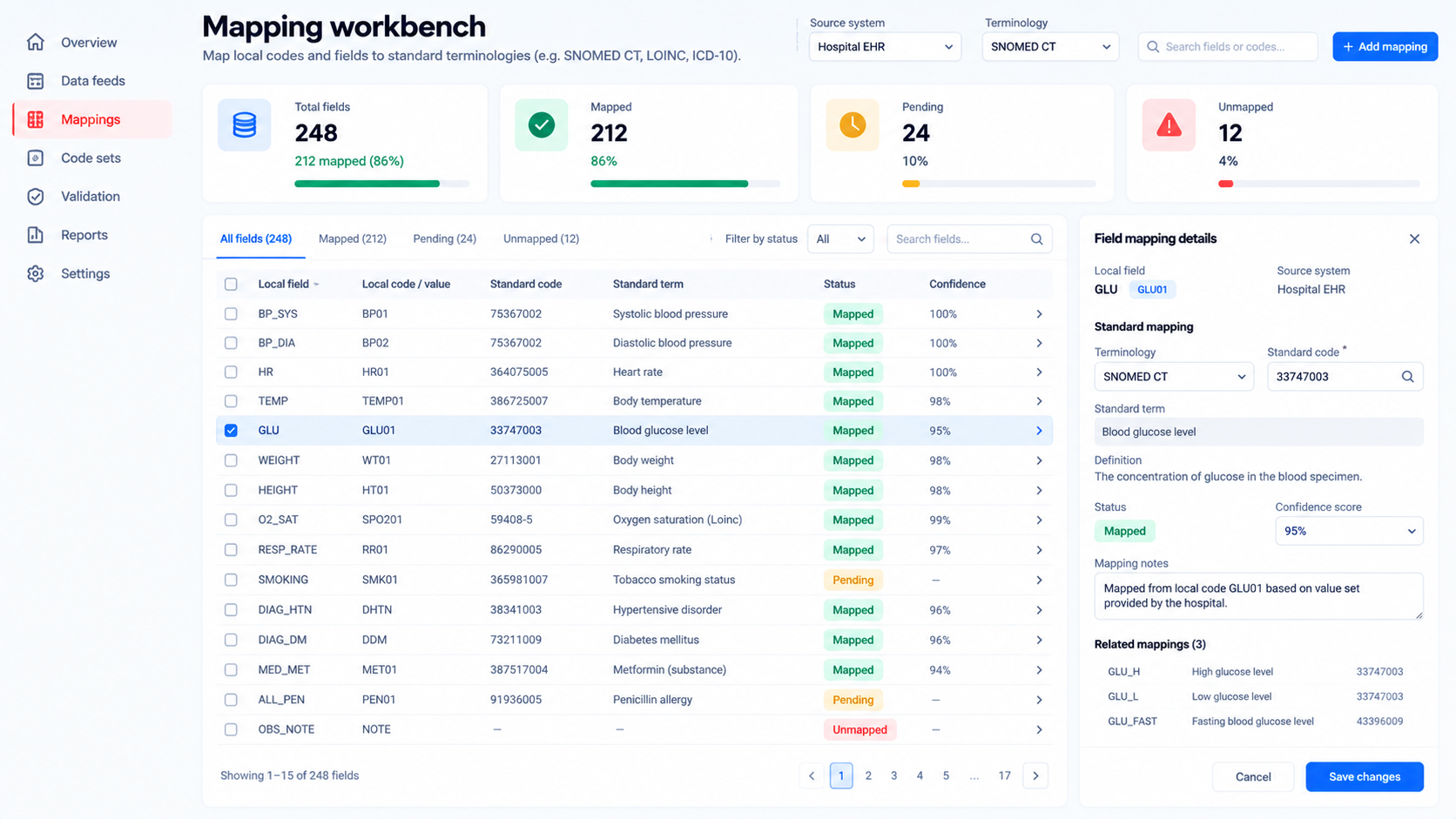
Data mapping
Reconciling code systems, units and local extensions between your model and theirs.
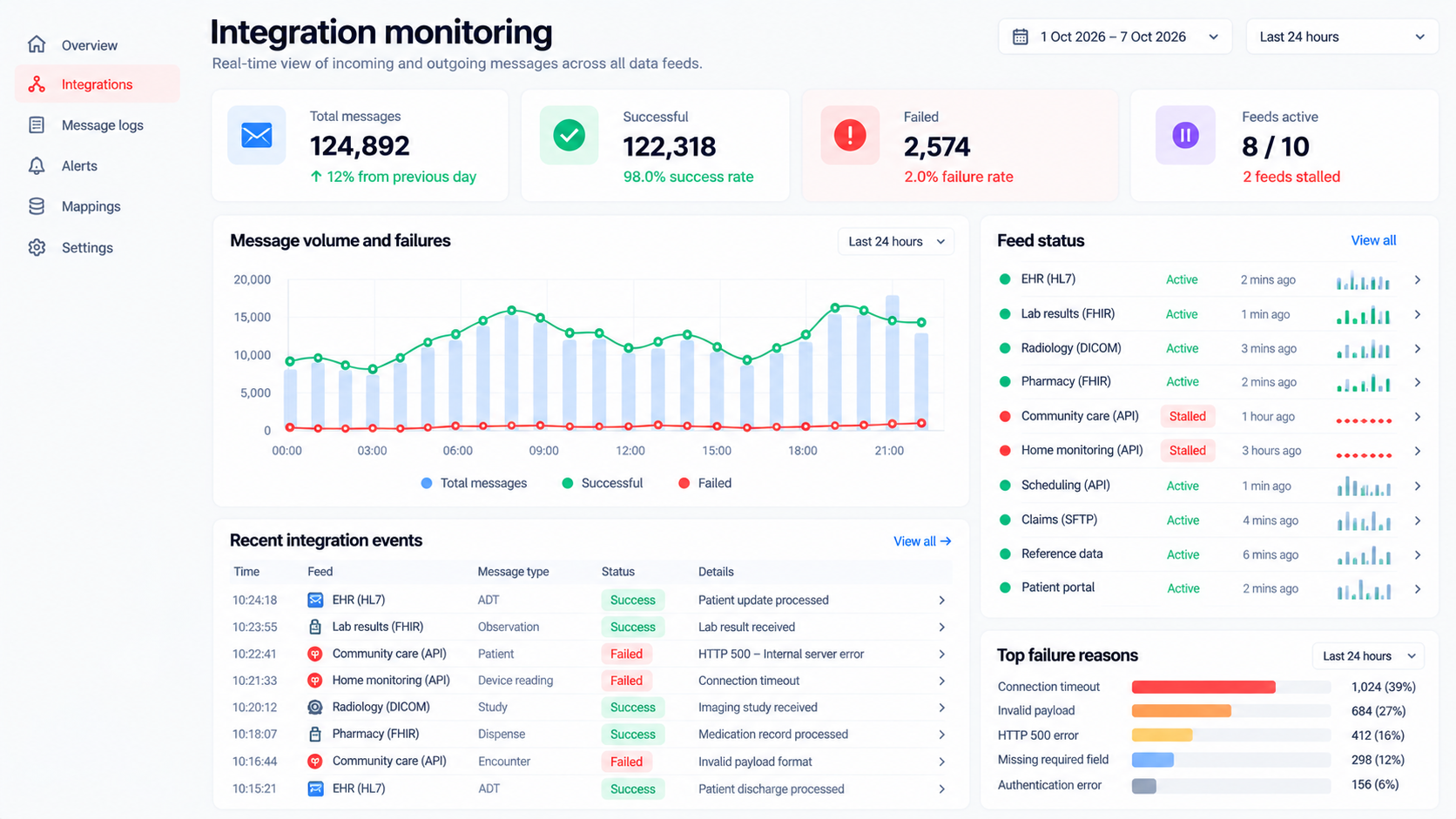
Integration monitoring
Alerting when a feed stops, a message fails or a queue builds up, so the first person to notice is not a clinician.
Integration architecture
Deciding where integration logic belongs so each new customer does not require a new bespoke build.
Authorisation
OAuth 2.0, SMART App Launch and scope design that will pass a customer security review.
Integration in practice
What this looks like in practice
| Situation | What is involved |
|---|---|
| A new enterprise customer requires EHR integration before go-live | Interface discovery, access and approval process, mapping, a test plan against their environment, then production cutover |
| Your product must appear inside the clinician’s EHR | SMART on FHIR launch, context handling, scope negotiation, sign-off from the customer’s IT team |
| A laboratory result must reach your platform | HL7 v2 ORU handling, code mapping to your model, error handling for unmatched patients |
| Device readings need to reach the clinical record | FHIR Observation writing, decisions about frequency and level of detail |
| Several customers each run a different EHR | An integration layer that isolates the differences, so adding a customer does not fork the product |
Frequently asked questions
The engineering is often the shorter part. Access approval, security review and scheduling with the customer’s IT team usually set the timeline, and that varies considerably between organisations. We ask for the specific system and version early.
Not immediately, though it is worth building towards. Many organisations run both, with v2 carrying existing message flows and FHIR used for newer work. A sensible architecture supports both without duplicating your business logic.
Those vendors publish FHIR APIs and app programmes, and integration is achievable through them. What is possible depends on the specific installation and the approvals the customer grants. [CLIENT INPUT REQUIRED: name only the EHR systems you have genuinely integrated with.]
There are usually alternatives: a file exchange, a database view, an interface engine already installed, or in some cases a gateway. They are less elegant and they work. We would rather tell you at planning than discover it in build.
You do, and it needs monitoring. Integrations break quietly when a system upgrades. We build in alerting for failed messages and stalled feeds, and hand over runbooks for the common failure modes.
Talk to us about an integration
Tell us which systems need to exchange information and what has to move between them. We can usually tell you quickly whether the approach you are considering will work.