
Healthcare AI
development
Agents, document intelligence and predictive models, scoped to real tasks and reviewed by a person where it matters.
Most healthcare AI projects stall for the same reasons
The interest is never the problem. Projects stall when nobody decided early who checks the output, where the model gets its information, and what happens on the day it is wrong.
Gartner expects more than four in ten agentic AI projects to be cancelled by the end of 2027, largely on unclear value and weak governance. The projects that survive tend to be narrow, well scoped and aimed at work that is repetitive and reversible.
Healthcare AI capabilities
Conversational AI and patient support
Intake, triage routing, appointment assistance and patient query answering, with tight bounds on what the model can assert.
AI agents for operations
Multi-step administrative tasks within set permissions: eligibility checks, record updates, status chasing, document assembly. Every action logged.
Document and data extraction
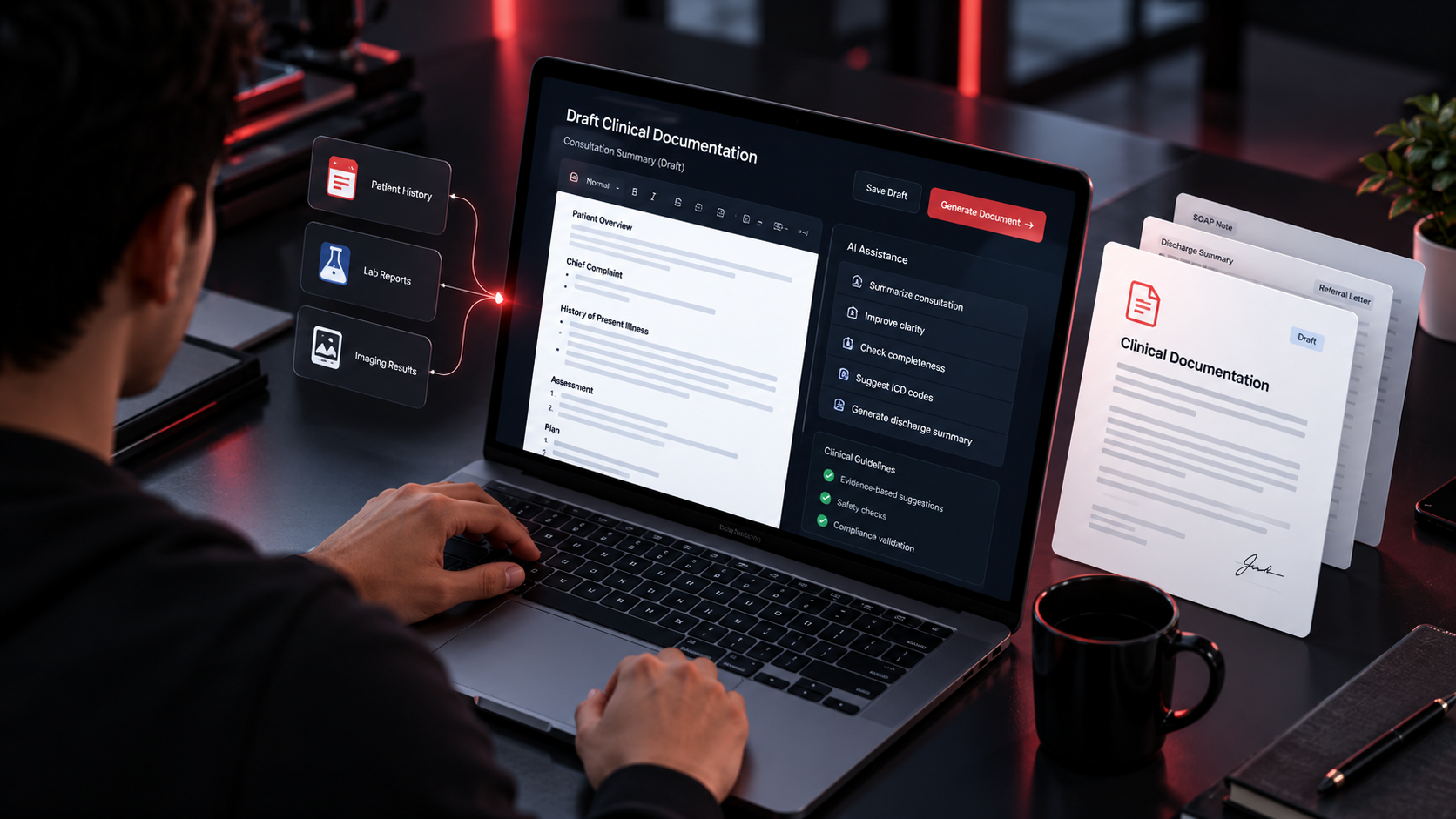
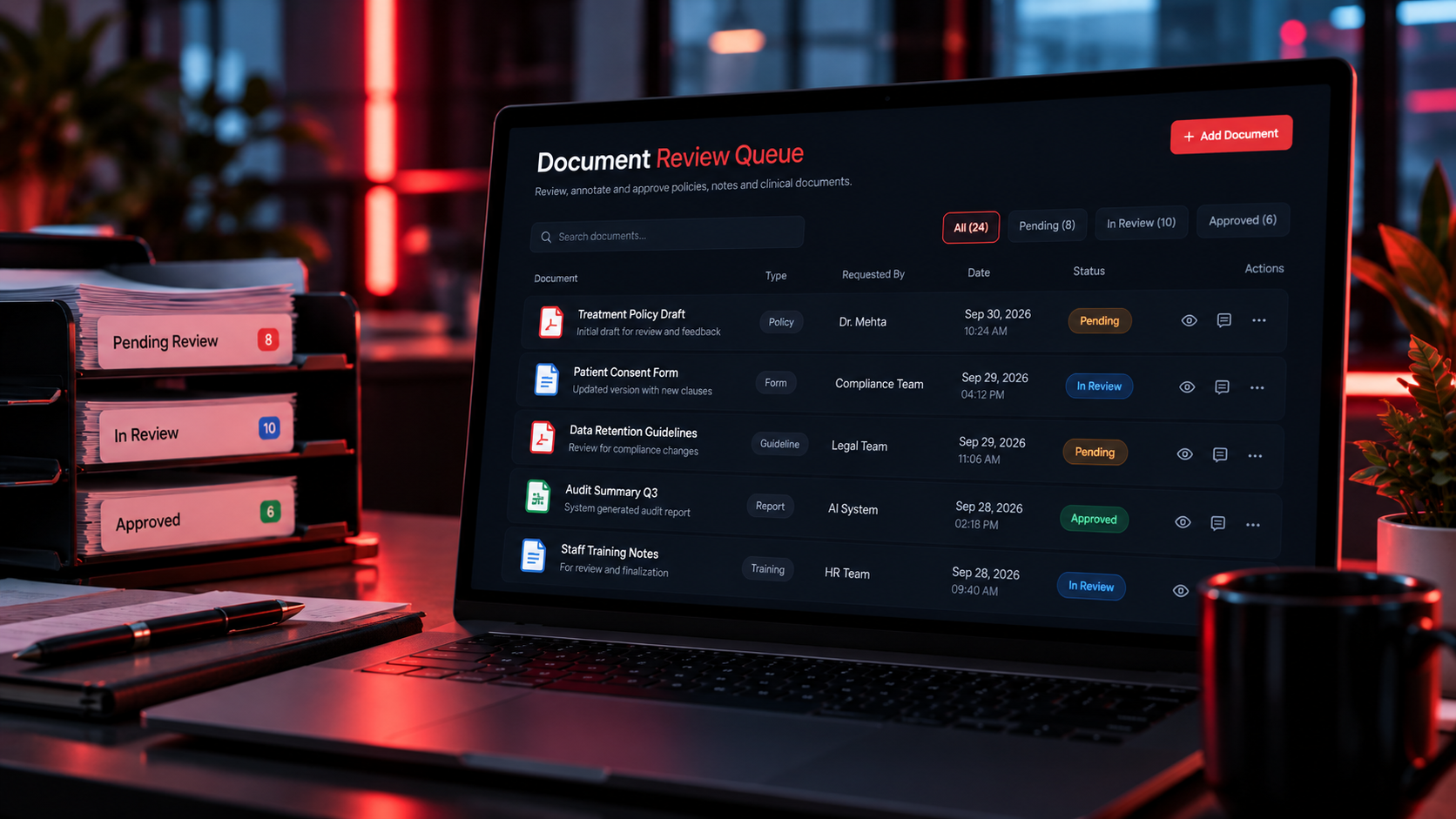
Referrals, intake forms and laboratory reports converted into structured data, with a confidence score and a review queue for anything uncertain.
Knowledge assistants
Answers from your own policies and documentation, with a citation back to the source so staff can check rather than trust.
Predictive models
Risk stratification, demand and capacity forecasting, care gap identification, built on data with a traceable origin.
Decision support
Information assembled and prioritised so a clinician reaches a decision faster. The decision remains with the clinician.
AI added to an existing product
New AI features in a platform you already run, built as a service it can call rather than as a rewrite.
AI feasibility assessment
A short piece of work establishing whether AI is the right approach, what data would be needed, and what it would cost to run.
Where healthcare organisations are using AI today
Adoption is concentrated in administrative and operational work, because the rules are known, the actions can be reversed and the value shows up quickly.
| Area | Practical example |
|---|---|
| Patient services | A patient asks when to stop eating before a procedure. The assistant answers from your own preparation guidance and records the exchange. |
| Intake | A referral letter arrives as a PDF. The fields are extracted, matched to a patient record and queued for confirmation. |
| Administration | Insurance eligibility is checked against the payer, the result written back, and anything ambiguous routed to a person. |
| Documentation | A long clinical history is summarised for a clinician before an appointment, with links to the source entries. |
| Operations | Appointment demand forecast by clinic and specialty so that staffing can be planned. |
| Coding support | Documentation checked for missing detail before submission, with suggestions a coder accepts or rejects. |
Healthcare AI in practice
Two patterns with clear governance boundaries that work well as a first production deployment.
How we build it
Six design principles that decide whether a healthcare AI system survives its first governance review.
Grounded in your material
Answers come from your documents and data, with the source shown, rather than from the model's general knowledge.
Permissions per action
An assistant that can read a record is not automatically allowed to change one. Each action is granted separately.
Review where it counts
Review points are set according to what the output affects, not applied uniformly across everything.
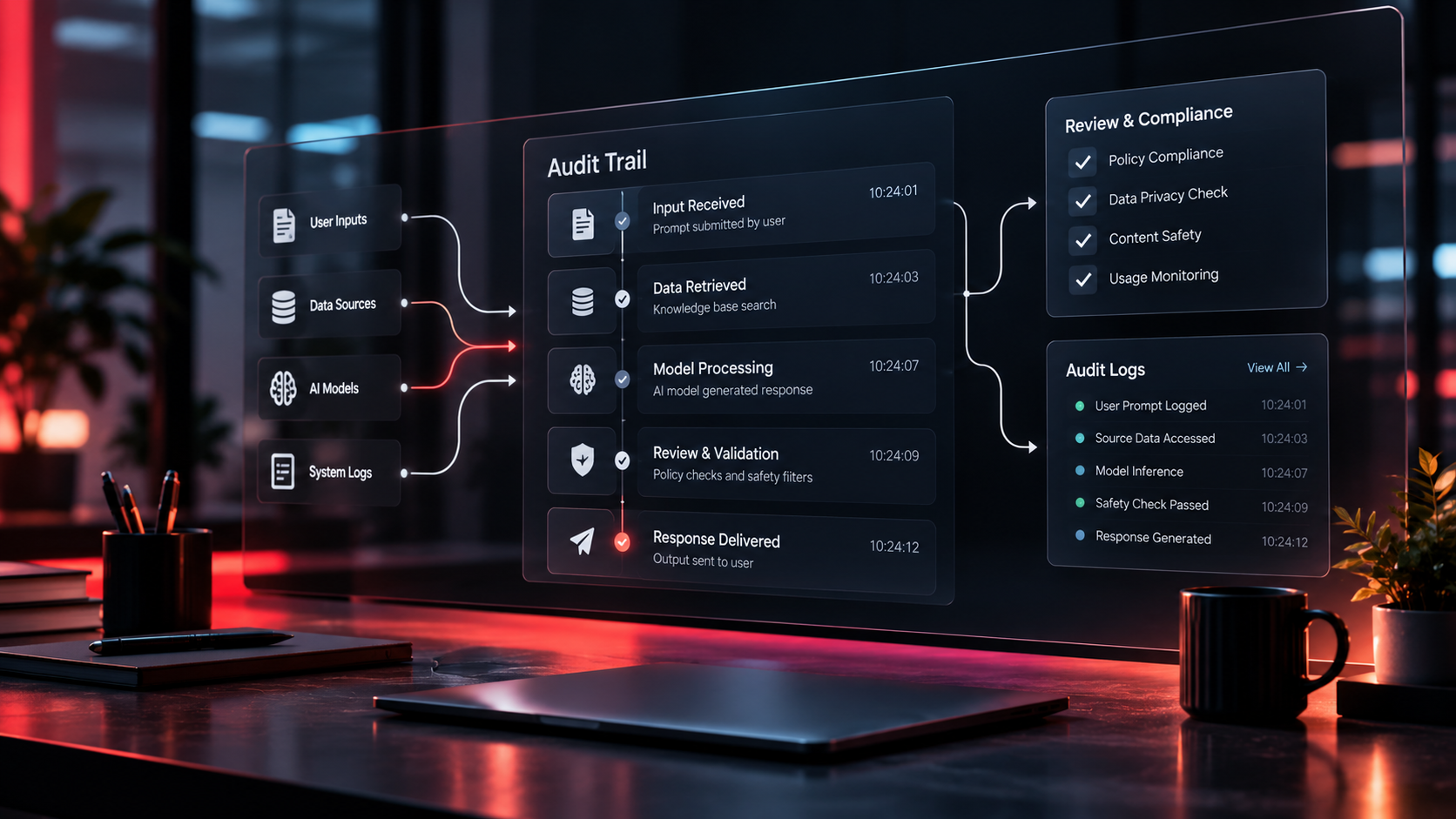
Logged and reviewable
Inputs, sources, actions and outcomes recorded so a decision can be reconstructed later.
Tested before release
AI behaviour is evaluated against agreed criteria, then monitored for change once live.
Model-agnostic
Commercial, open-weight or privately hosted models, chosen on the requirement, including deployment inside your own environment.
What we work with
| Group | Technologies |
|---|---|
| Language models | OpenAI, Anthropic Claude, Google Gemini, open-weight clinical models (Llama, Mistral) hosted in private cloud / HIPAA-compliant VPC |
| Retrieval and search | Vector databases, hybrid search, document processing pipelines |
| Machine learning | Python, scikit-learn, PyTorch, managed training services |
| Deployment | Containerised services, private cloud or in-tenant deployment where required |
| Healthcare standards | FHIR APIs for reading and writing clinical data, HL7 where the receiving system needs it |
Governance in the interface
Frequently asked questions
Direct answers on clinical decision limits, hallucination safeguards, in-tenant cloud isolation, EHR interfaces, and project feasibility.
No, and we would not build a system that implied otherwise. AI can assemble information, summarise it, flag what looks unusual and prepare a recommendation. The clinical decision stays with the clinician, and the system is designed so the review step cannot be skipped.
By limiting where answers can come from. The system retrieves from your approved documents and data, shows the source for each answer, and is set up to say that it does not know rather than produce something plausible. We test this before release and monitor it afterwards.
Yes. Where data cannot leave your tenancy or your country, models can be deployed inside your own cloud environment. This affects cost and performance, so it is worth deciding early.
Usually, through FHIR APIs where the system supports them and HL7 interfaces where it does not. The practical question is what your particular installation exposes, which we check during planning rather than assume.
A focused proof of concept on a single process is typically a matter of weeks. Moving it into production, with the integration, security review and monitoring that requires, takes considerably longer. We give a timeline after planning rather than before it.
We will say so. Several of the problems brought to us are better solved with a rules engine, a process change or a straightforward integration, and those are cheaper to build and easier to run.
Talk to us about a healthcare AI project
Bring the process you want to improve and the systems it touches. We will tell you whether AI is the right approach before anyone writes a proposal.